VEDIC MATHEMATICS IN THE AGE OF AI AND STEM
The Relevance of Ancient Calculation Techniques
in Modern Technological Advancements
Introduction
Artificial Intelligence is changing the world around us. From smart assistants and self-driving technologies to robotics, data science, and personalized learning, AI is becoming part of everyday life. For today's children, the future will look very different from the world their parents grew up in. So, as technology becomes increasingly powerful, what skills should children develop to thrive in this new world?
The answer isn't simply more technology. It is better thinking. And this is where Vedic Mathematics can play a valuable role.
Far from being just a collection of shortcuts for faster calculations, Vedic Maths encourages children to develop mathematical flexibility, recognize patterns, approach problems from different angles, and become more confident with numbers. In an increasingly STEM- and AI-driven world, these are skills worth nurturing.
What Is Vedic Mathematics?
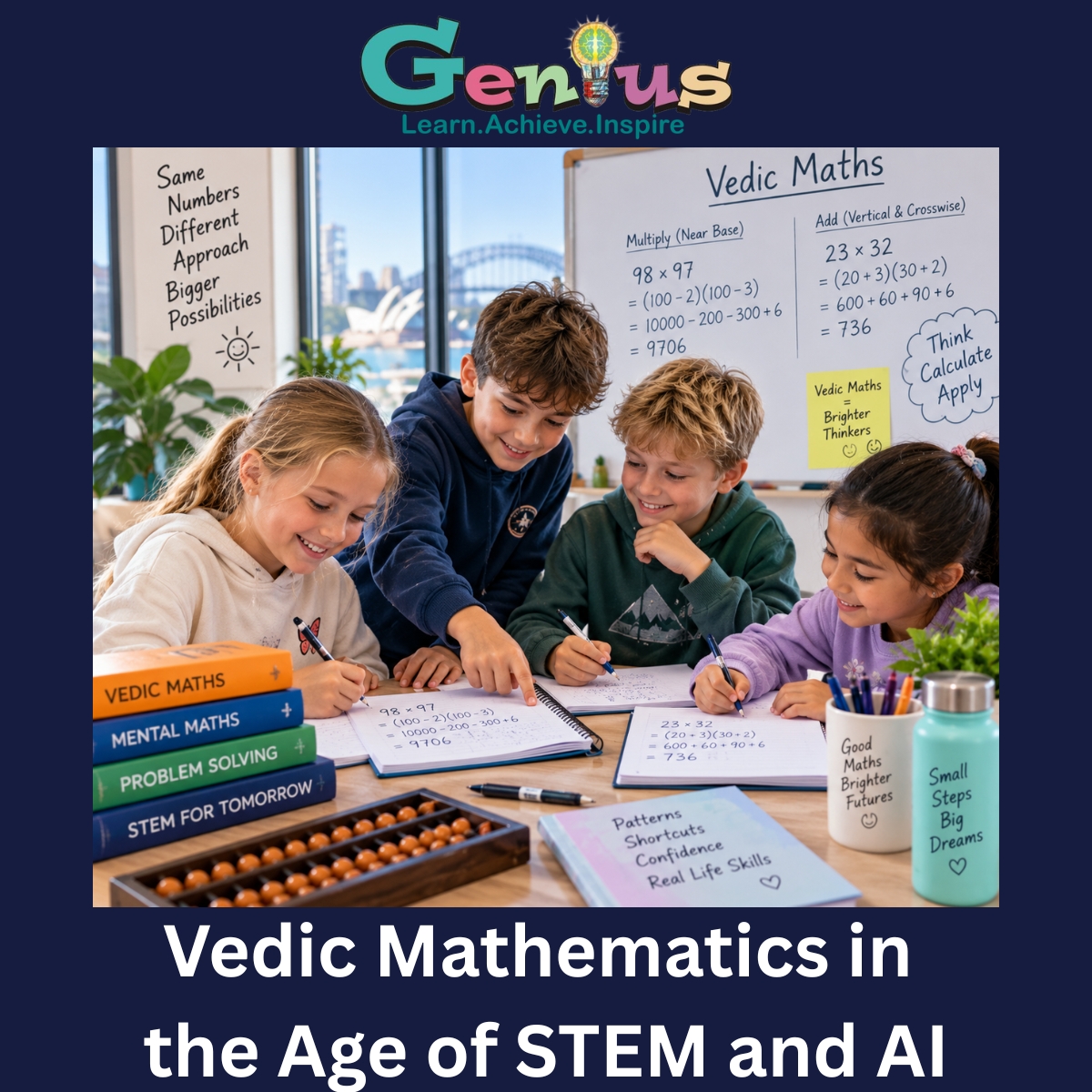
Vedic Mathematics refers to a system of mathematical techniques popularized in the 20th century through the work of Bharati Krishna Tirthaji. It is known for techniques that can simplify certain calculations and promote mental approaches to mathematics. Unlike traditional methods, where students may often learn one standard procedure for solving a problem, Vedic Maths encourages learners to look for patterns, relationships, and alternative strategies. For a child, this can transform a calculation from a routine exercise into a thinking challenge.
Why Is Vedic Maths Relevant in an AI World?
AI can perform calculations at a speed humans cannot match. So, does that make mental maths irrelevant? Quite the opposite. As machines become better at computation, uniquely human cognitive skills become even more important. Children need to learn how to:
- Recognize patterns
- Analyze information
- Think logically
- Estimate and check results
- Identify relationships
- Approach problems creatively
- Adapt when their first strategy doesn't work
Vedic Mathematics provides opportunities to practice several of these skills through number-based problem solving. The objective isn't to compete with a computer. It is to develop the mind that knows how to use the computer effectively.
Vedic Mathematics and STEM Education
STEM education brings together Science, Technology, Engineering, and Mathematics to encourage students to apply knowledge to real-world problems. Mathematics sits at the heart of almost every STEM discipline. Engineering uses mathematical modeling. Computer science relies on logic and algorithms. Data science uses statistics and probability. Physics uses mathematical relationships to describe the world. Artificial Intelligence itself is built upon mathematics, statistics, algorithms, and computational processes.
A child doesn't need to become an expert mathematician before exploring these fields. However, developing a strong mathematical foundation can make future learning more approachable. This is where mental maths and mathematical reasoning can contribute.
Building Number Sense
Number sense is the ability to understand numbers and their relationships rather than simply memorizing procedures. Vedic Maths activities can encourage children to manipulate numbers mentally, recognize numerical patterns, and look for efficient ways of calculating. This can complement the broader mathematical skills children develop through their school curriculum.
Developing Flexible Thinking
In STEM, there is rarely only one possible path to a solution. Engineers test different designs. Scientists investigate different hypotheses. Programmers debug and try alternative approaches. Mathematicians look for elegant solutions. Vedic Mathematics can introduce children to the idea that one problem can sometimes be approached in multiple ways. That is a valuable mindset far beyond mathematics.
The Connection Between Vedic Maths and Computational Thinking
One of the key concepts in modern STEM and technology education is computational thinking. Computational thinking involves breaking problems down, identifying patterns, recognizing relationships, and developing systematic approaches to solving problems. While Vedic Mathematics is not a coding or AI curriculum, certain activities within it can reinforce complementary habits of mind.
For example, when children are encouraged to identify patterns before calculating, they are practicing a form of structured observation. When they break a complex calculation into simpler parts, they are learning to decompose a problem. When they compare different calculation strategies, they are evaluating efficiency. These are valuable thinking habits in many areas of learning.
Speed + Accuracy + Reasoning
Vedic Maths is often associated with speed. And yes, practicing mental calculation can help children become faster with certain types of numerical problems. But speed should not be the only measure of success. A child who calculates quickly but doesn't understand the reasoning behind an answer has limited mathematical flexibility.
The real goal should be a balance of:
When children become comfortable with numbers, they may also become more willing to tackle challenging problems. And confidence can change the way a child approaches learning. Instead of avoiding a difficult question, they may think:
“Let's try another way.”
That is a powerful habit.
Can Vedic Maths Help Children Learn AI?
It is important to be realistic. Learning Vedic Maths does not automatically teach a child Artificial Intelligence. A child will still need to learn programming, algorithms, data, statistics, and other concepts to develop AI-related skills. However, Vedic Maths can be part of a broader mathematical foundation. Think of it as one piece of the puzzle.
There is no single subject that creates an "AI-ready" child. Instead, children benefit from developing a combination of mathematical, technological, creative, and communication skills.
What AI Cannot Replace
The rise of AI has created an important conversation about education. If a machine can calculate an answer instantly, should children still learn mental maths? If AI can write code, should children still learn programming? If AI can answer questions, should children still learn how to research? Yes. Because education isn't simply about producing answers. It is about developing the ability to understand, question, and evaluate answers.
Imagine an AI system gives a student a mathematical solution. The important question isn't only:
“Did the AI give me an answer?”
It is:
“Does the answer make sense?”
That requires reasoning. And reasoning requires a strong foundation in thinking.
Preparing Children for a Technology-Rich Future
The future workplace will likely require people who can work with AI rather than simply compete against it. Children will need to be comfortable with technology while also developing skills technology cannot easily replace:
Mathematics can contribute to several of these foundations. Vedic Maths adds another dimension by encouraging children to explore numbers in flexible and often unconventional ways.
Why Parents Should Look Beyond Marks
For many parents, mathematics is still closely associated with grades and examination results. But mathematical education can offer much more. When children develop confidence with numbers, they may become more comfortable experimenting, making mistakes, and trying different approaches. This is particularly important in STEM. Innovation doesn't happen when children are afraid of getting an answer wrong. It happens when they are willing to ask:
“What if I try this?”
That curiosity is something we should actively encourage.
Vedic Mathematics: An Ancient Inspiration for a Modern Future
The fascinating thing about Vedic Mathematics is the contrast between its traditional roots and its potential relevance to modern learning. The world around us has changed dramatically. We now have smartphones, robotics, machine learning, and generative AI. Yet one thing remains unchanged:
Vedic Mathematics can provide an engaging way for children to explore numbers, patterns, and problem-solving while complementing their broader mathematics and STEM education.
It shouldn't replace the school curriculum. It shouldn't be presented as a shortcut to becoming an AI expert. Instead, it can be seen for what it can be at its best: a tool for developing mathematical confidence and flexible thinking.
The Future Needs Thinkers, Not Just Technology Users
AI will continue to evolve. The tools available to children today may look completely different in five or ten years. But the ability to recognize a problem, understand it, question assumptions, and find an effective solution will remain valuable. That is why foundational mathematical skills still matter. That is why mental maths still matters. And that is why approaches such as Vedic Mathematics can have a meaningful place within modern STEM education.
At Genius Abacus, We Believe in More Than Maths.
We believe every mathematical challenge is an opportunity to develop a thinking mind. Through Abacus, Vedic Maths, and our broader learning programs, our goal is to help children become more confident with numbers while developing the concentration, reasoning, and problem-solving habits that can support them in school and beyond. Because the future may belong to AI—
but the future still needs human minds to guide it.
More than Maths. A foundation for life.